
Tarique Rahman is Bangladesh's first male prime minister in more than three decades, ending an era of female leadership that began in 1991.

12 out of 21 public sector banks reported declines in their loan books in the last financial year against seven such banks in 2015-16 and none in 2013-14.

Border 2 saw the best opening ever for Bollywood since last year's Chhaava.

'The trade deficit in some sectors is huge and that is an area of opportunity to localise.'

The country's largest IT services company TCS on Monday reported 13.91 per cent decline in December quarter net profit at Rs 10,657 crore. The Tata Group company had posted a net profit of Rs 12,380 crore in the October-December period of FY25 and Rs 12,075 crore in the preceding September quarter.

Tarique Rahman, after 17 years in self-exile, has led the Bangladesh Nationalist Party (BNP) to a significant victory, becoming the country's Prime Minister. This marks a major turnaround for the BNP after years of being targeted by the Awami League government.

'Global uncertainty is something which definitely occupies the minds of officials when we are preparing for the Budget.'

'Earnings growth will be the main driver of India's market in 2026, with profits expected to rise 9% to 10% in H2 FY26 and accelerate to 12% to 15% in FY27.'

Bad loans, however, continued to rise in the micro, small and medium enterprises category

'The atmosphere he has created in the team -- he has tried to infuse a culture of playing for the team and not focusing on personal milestones.'

With foreign banks registering a paltry 4 per cent growth in credit advances for the financial year up to March 27, 2009 and private sector banks not doing much better at 10.9 per cent, the extent of credit slowdown is marked in these banks.

Non-banking financial companies (NBFCs) such as Bajaj Finance, Shriram Finance, Muthoot Finance, and IIFL Finance have regained their growth momentum after losing market share to banks in the post-Covid period. The growth surge is being led by diversified lenders and gold-loan companies while development-finance institutions such as Power Finance Corporation (PFC), REC, and Housing & Urban Development Corporation (Hudco) continue to grow at a slower pace.

Months after picking up 24.21 per cent stake in private sector lender Yes Bank, Japan's Sumitomo Mitsui Banking Corporation (SMBC) has received the Reserve Bank of India's (RBI's) in-principle approval for setting up a wholly owned subsidiary (WOS) in India.

While participants in the domestic financial market are expecting a 25 basis-point policy repo rate cut in the December meeting of the Monetary Policy Committee (MPC) of the Reserve Bank of India (RBI), economists remain torn between a reduction in rate cut and a pause.

Restoring weighted tax deductions and adopting a petty patents regime can foster firm-level innovative activity critical for competitiveness, points out Nagesh Kumar.

Co-working spaces provider WeWork India is aiming for a revenue growth of over 20 per cent for the coming years, even as its initial public offering (IPO) with only an offer for sale (OFS) component gets valued at Rs 3,000 crore at the top of the price band. The IPO opens on October 3, a newspaper advertisement said.

State debt is rising because revenues are disappointingly weak. Ten states have debt ratios exceeding 30 per cent. In 2023-2024, states were borrowing simply to meet day-to-day expenses, points out Debashis Basu.

The Indian government should urgently consider imposing safeguard or anti-dumping duties on imports of two construction equipment segments - crawler excavators and tower cranes - as Chinese companies are rapidly expanding their presence in these markets in India through 'predatory' pricing supported by lower raw material costs, substantial export subsidies, and extended credit schemes, said Sorab Agarwal, executive director at Action Construction Equipment (ACE).

Despite corporate bond yields hardening by 20-25 basis points, Indian corporates are not warming up to bank funding for their capital expenditure needs as bank lending rates remain elevated due to the higher cost of liabilities, compared to current rates in the debt capital market.
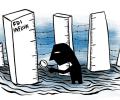
Leading non-banking financial company (NBFC) Shriram Finance on Friday said Japan-based MUFG Bank would invest Rs 39,618 crore, or $4.4 billion, to acquire a 20 per cent stake on a fully diluted basis through a preferential issue of equity shares.

The meeting will review annual financial performance of public sector banks, credit offtake in the economy, priority sector lending and progress made under various social sector schemes, including Atal Pension Yojana (APY) and Pradhan Mantri Jan Dhan Yojana.
Asset quality within the non-banking financial sector (NBFCs) deteriorated with the share of stressed assets rising to 5.9 per cent in March 2025 from 3.9 per cent in September 2024, according to the Reserve Bank of India's Financial Stability Report (FSR). Slippage ratios among upper layer NBFCs have been rising, along with an upward trend in loan write-offs.
With inflation comfortably below the Reserve Bank of India's (RBI's) 4 per cent median target and likely to undershoot its 3.7 per cent projection for 2025-26 (FY26), there is room for the monetary policy easing cycle to be sustained, the Finance Ministry said on Monday. The comments, featured in the ministry's Monthly Economic Review for June 2025, assume significance ahead of the Monetary Policy Committee (MPC) meeting of the Reserve Bank of India (RBI) scheduled to begin from August 5.

This is the first Budget in my memory of Budgets over the last half a century which has embraced upfront, enthusiastically and emphatically, technology, modernity and fiscal sobriety, notes Shreekant Sambrani.

'Only four or five original companies remain; the rest have been replaced every decade as sectors evolve or leadership shifts.' 'Companies that fail to adapt -- like many textile mills from the 1970s and shipping firms from the 1980s -- disappear.' 'Benchmark indices reward those who reinvent themselves in line with economic demands.'

Bajaj Finance's shares fell more than 7 per cent on Tuesday after it trimmed growth guidance for FY26, from 24-25 per cent projected earlier to 22-23 per cent.

There is a need for real-time or near real-time credit reporting, instead of the current fortnightly system, to improve underwriting precision, enable timely reflection of borrower actions such as loan closures or repayments, and deliver a superior consumer experience, Deputy Governor of the Reserve Bank of India (RBI), M Rajeshwar Rao said on Wednesday.

'Beating India here is never easy, in any format. To do it with this group makes it very special for New Zealand cricket.'

India is on track to exceed the $4 trillion milestone in 2025-26 (FY26), surpassing the $3.9 trillion gross domestic product (GDP) mark recorded at the end of March 2025, Chief Economic Adviser (CEA) V Anantha Nageswaran said on Tuesday.

S&P Global Ratings on Thursday said the hostilities between India and Pakistan heighten risks to the credit metrics of both countries, and any escalation in clashes would put downward pressure on sovereign credit support.

The government has circulated among members ofParliament a new draft of the Amendment of Insurance laws Bill, 2025, proposing stricter safeguards on the utilisation of life insurance funds and other specified insurance business funds, particularly for dividend payouts, bonuses, and servicing of debentures.

The US' move to raise the tariff on most Indian goods to 50 per cent could drag India's GDP growth for FY26 by 35 to 60 basis points, according to various economists. One basis point (bp) is equal to 0.01 per cent.

Moody's Ratings on Tuesday said tax cuts in the current fiscal has dented India's revenue growth, leaving less scope for fiscal policy support for the economy.
Analysts have largely maintained their positive outlook on HDFC Bank, as the private lender reported in-line results for the October-December quarter (Q3) of the current financial year (2024-25/FY25). They believe the results were 'strong' given the tough macro environment, and relative to peers.

Prime Minister Narendra Modi and Maldivian President Mohamed Muizzu held talks focusing on trade, defence, and infrastructure cooperation, signaling a turnaround in relations after a period of strain.
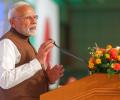
Showcasing India as an attractive investment destination, Modi said the country has political and economic stability as well as transparency and predictability in policy decisions.

Former India star Anjum Chopra believes Harmanpreet Kaur remains the "best person" to lead the women's national team even as debates around captaincy resurface ahead of a busy international season and the upcoming Women's Premier League (WPL).

The reduction in the number of loan accounts and the outstanding amount during the last financial year is a cause of concern and stress for microfinance institutions (MFI), Secretary, Department of Financial Services, M Nagaraju said on Thursday, highlighting "inefficiency" in MFIs that leads to higher rates of interest.

The reduction in goods & services tax (GST) on individual life and health insurance premiums has been called a "landmark step" for making insurance affordable and inclusive. In a panel discussion at the Business Standard BFSI Insight Summit 2025, Anup Bagchi, managing director (MD) & chief executive officer (CEO) of ICICI Prudential Life Insurance; Mahesh Balasubramanian, MD & CEO of Kotak Life Insurance; Tarun Chugh, MD & CEO of Bajaj Life Insurance; and Ratnakar Patnaik, MD of Life Insurance Corporation of India (LIC), listed what else the industry needs to reach more people.
The country's largest private sector lender HDFC Bank on Saturday said it will grow its loan book slower than the industry in the current financial year (FY25). The move comes as the lender looks to bring down its elevated credit - deposit (CD) ratio to pre-merger levels. "We will bring down the CD ratio faster than what we had anticipated.
